The granite summit of Malindidzimu — also known as World's View — in the Matobo Hills of Zimbabwe, with balancing boulders and the bronze Rhodes plaque set into two-billion-year-old rock
Culture & History · Matobo National Park

Rhodes Grave & World's ViewThe Granite Summit at the Heart of the Matobo Hills

On Malindidzimu — the Place of Benevolent Spirits — a contested grave shares one of Africa's great views. This is what the summit actually holds, and how to visit it well.

Updated April 2026 11 min read

Stand at the top of Malindidzimu on a windless morning and the whole argument of the place is immediately legible. A granite dome falls away beneath you in every direction. The horizon is a long, soft rhythm of more domes — two billion years of rock weathered into slow curves. Somewhere in the middle distance a fish eagle calls and the sound travels further than it has any right to.

At your feet, set into the stone, is a slab of polished granite with a bronze plaque. The man beneath it asked to be buried here in 1902. The mountain under his back was sacred long before he ever saw it.

That is the summit, in two sentences. Everything else — the history, the controversy, the view, the walk up — is commentary.

At a Glance

Rhodes Grave & World's View, in brief

Where

Inside Matobo National Park

Roughly 45 km south of Bulawayo. The summit is accessed by a short drive from the park gate and a 15–20 minute walk up a cut-granite staircase.

What's on the summit

Three graves and a memorial

Cecil Rhodes, Leander Starr Jameson and Charles Coghlan, all set into the granite dome. A short walk away, the Shangani Memorial commemorates the 1893 Wilson Patrol.

How long

A two to three hour visit

Best visited early morning or late afternoon when the light on the granite is warm and the summit wind is gentle. Most guests pair it with rhino tracking or the rock art caves.

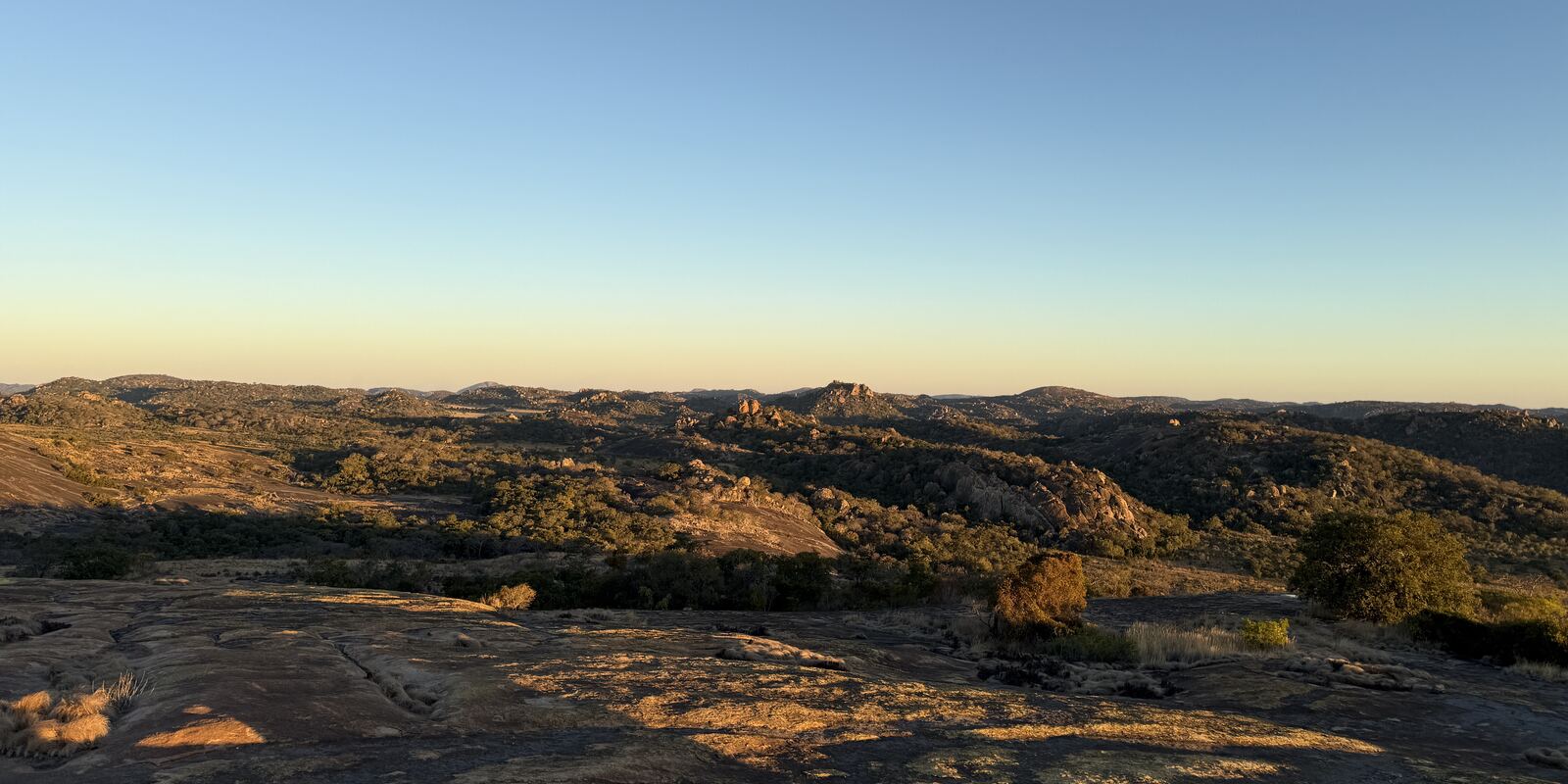
Panoramic view of granite kopjes and whaleback domes rolling across the Matobo Hills landscape in Zimbabwe

What World's View actually is

The peak sits at roughly 1,460 metres above sea level, near the northern edge of the Matobo Hills. The Ndebele call it Malindidzimu — a name usually translated as the Place of Benevolent Spirits, a site where, in the Ndebele tradition, the ancestors gather and the living come to ask for their help. It is sacred ground, and it has been sacred for a great deal longer than anything currently on it.

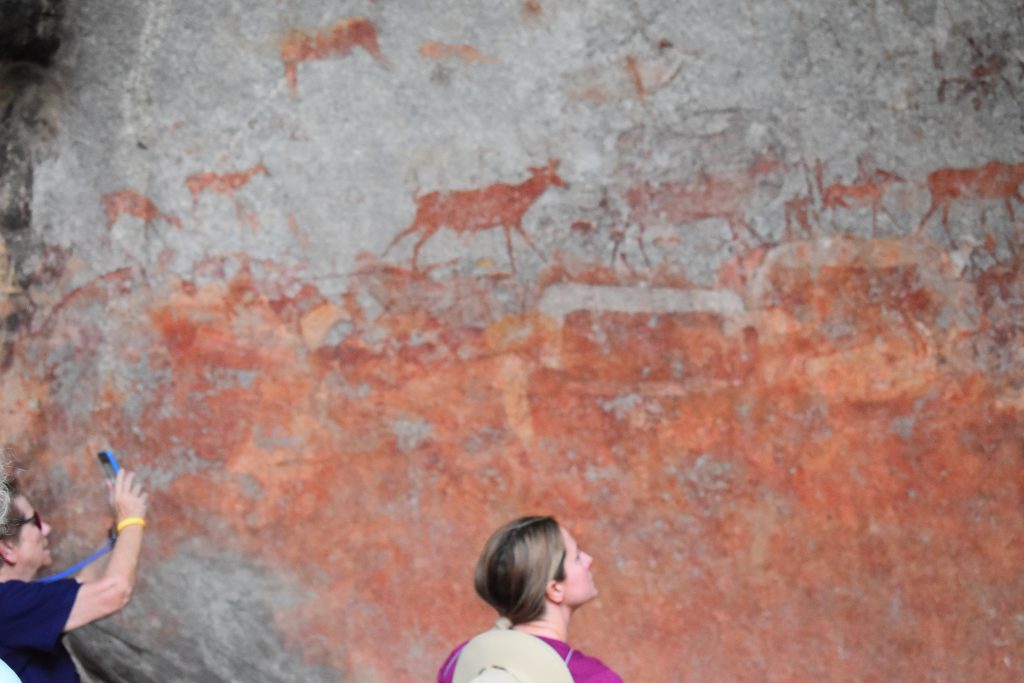
The granite is two billion years old. It was pushed up as a single molten mass, cooled slowly underground, and then — over the course of a geologic lifetime — exposed as the softer rock around it weathered away. What you see today is the core of that intrusion: a series of smooth, sheet-like domes the geologists call exfoliation domes, and that everyone else tends to call whalebacks. They are the characteristic landform of the Matobo system, and together with some 3,000 rock art sites they are why the broader Matobo Hills was inscribed as a UNESCO World Heritage Cultural Landscape in 2003.

The view from the summit is not dramatic in the way a mountain peak is dramatic. It is unusually calm. The domes don't spike or shatter; they rise and fall. The eye reads the horizon as a slow horizontal rhythm that carries sixty or seventy kilometres on a clear day. Rhodes, when he first saw it, is said to have called it a View of the World. The English name stuck.

A very short chronology of the summit

~2 Billion Years Ago

The granite intrusion that forms the Matobo batholith cools underground — the same rock you now stand on at the summit.

Centuries before colonisation

Malindidzimu is established as a place of ancestral spiritual significance in Ndebele and Kalanga tradition.

1868

Mzilikazi, the first Ndebele king, is buried in the Matobo Hills at Entumbane, not far from this summit.

1902

Cecil Rhodes is buried on the summit by his own instruction. The site is given the English name World's View.

1904

The Shangani Memorial is unveiled a short walk from the grave, commemorating the 1893 Wilson Patrol.

2003

The Matobo Hills Cultural Landscape is inscribed as a UNESCO World Heritage Site.

On the summit

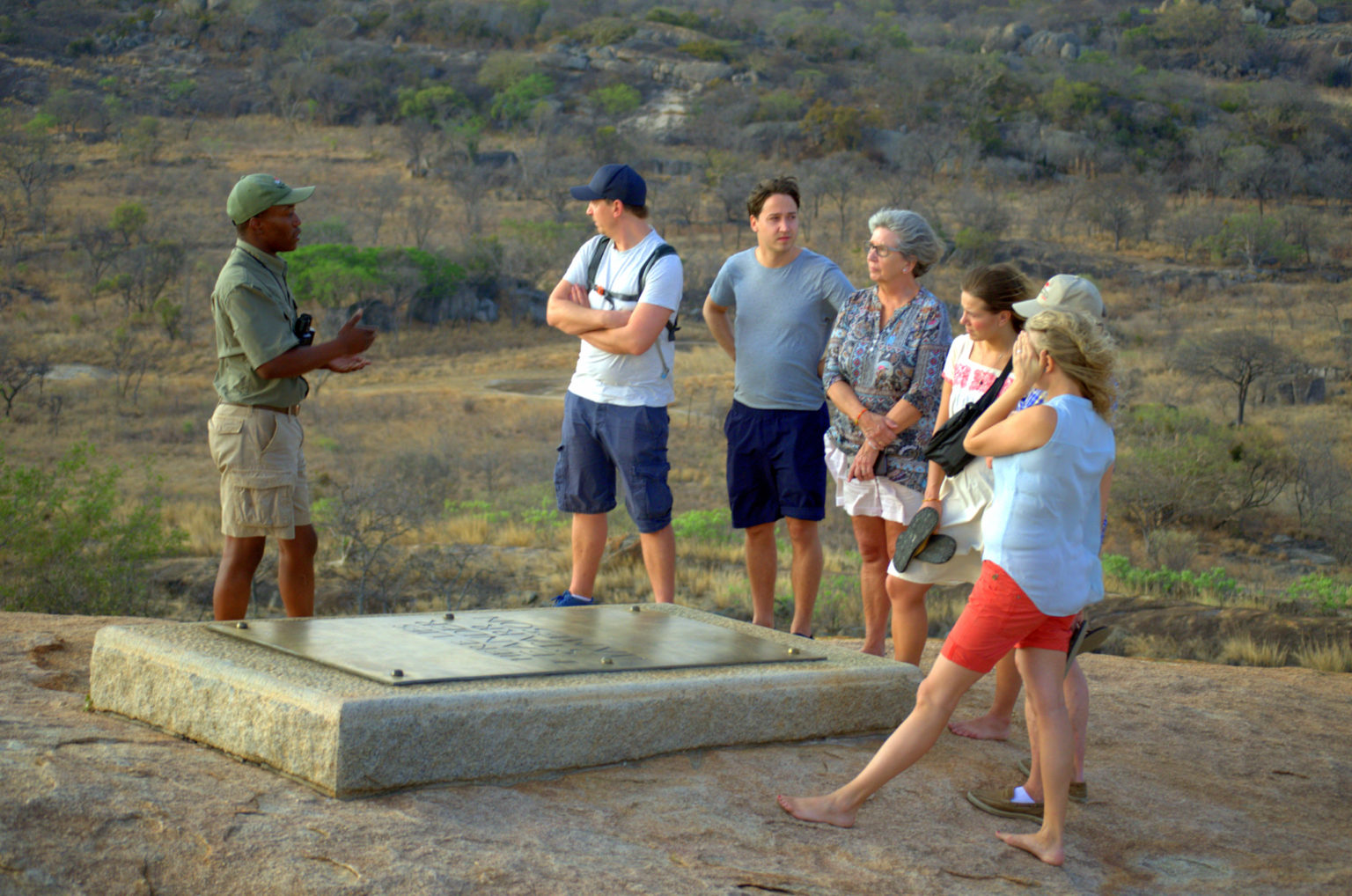
At the highest point of the dome is the granite slab. The inscription is plain: Here lie the remains of Cecil John Rhodes. A low iron chain surround frames it. Two further graves sit adjacent — Leander Starr Jameson, architect of the 1895 Jameson Raid, and Sir Charles Coghlan, the first Prime Minister of Southern Rhodesia. All three were deliberately placed on the summit.

The granite slab and bronze plaque marking the grave of Cecil John Rhodes on Malindidzimu in the Matobo Hills
The grave is a single slab of polished granite set into the dome. The bronze plaque, the iron surround, and the rock itself are the entire monument.

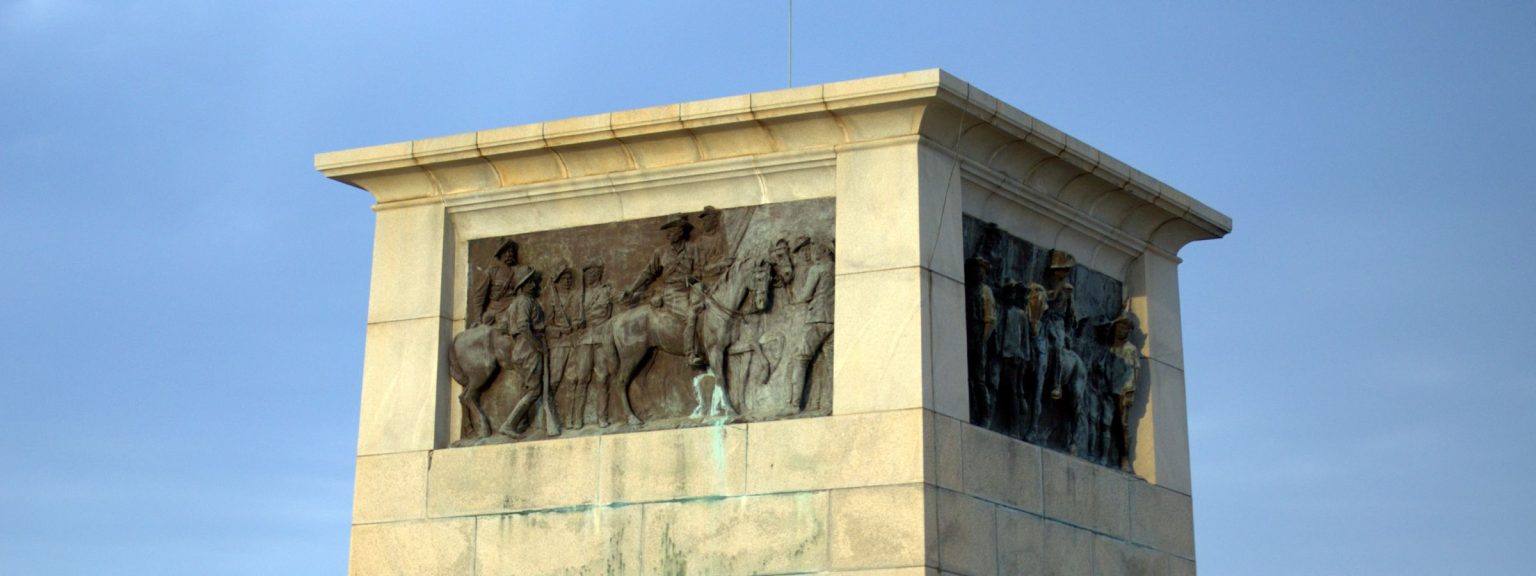
A short walk to the east, along a broad granite shelf, sits the Shangani Memorial. It is a small stone structure with a bronze frieze by the sculptor John Tweed, unveiled in 1904. The frieze depicts the thirty-four men of the Wilson Patrol who were surrounded and killed by an Ndebele impi at the Shangani River in December 1893, during the First Matabele War. Two of the men named on the memorial were never found; the others were originally buried where they fell before being moved here.

Close-up of the bronze plaque reading 'Here Lie the Remains of Cecil John Rhodes', set into polished granite on the summit of Malindidzimu in the Matobo Hills
The inscription, up close. Seven words in weathered bronze: Here lie the remains of Cecil John Rhodes — the entire text of the monument.

Beyond those graves and that memorial, the summit is empty. No visitor centre up top, no café, no interpretive panels other than a single small plaque. The wind, the rock, the view.

The weight of the place

This is not an uncomplicated site, and no honest visitor's guide can pretend otherwise.

Cecil Rhodes founded the British South Africa Company in 1889. The Company occupied Mashonaland in 1890 and Matabeleland in 1893, the latter by force in a war that ended with the death of King Lobengula. Rhodes never lived in what was then called Rhodesia, but his Company administered the territory, and the country bore his name until 1980. A serious account of his life has to sit with all of it — the industrial scale of his influence, the racial hierarchies he entrenched, and the lasting consequences of decisions he made in London and Cape Town for a land he visited only occasionally.

Portrait photograph of Cecil John Rhodes, the British-born mining magnate and politician buried on Malindidzimu in 1902
Cecil John Rhodes (1853–1902). His instruction was to be buried on this specific summit — a deliberate choice that placed a colonial monument directly on one of southern Africa's older sacred landscapes.

The summit he chose for his burial sits inside a landscape that was sacred long before him. Malindidzimu and the surrounding Njelele shrines are among the most important spiritual sites of the Ndebele and the Kalanga. The mountain's earlier dead include Mzilikazi, the first Ndebele king, buried in the hills in 1868. The burial of Rhodes on this specific summit in 1902 placed a colonial monument directly on top of an older sacred geography — a fact widely understood at the time, and explicitly part of the site's selection.

Whether the grave should remain has been publicly debated since at least the 1960s, and in cycles since. It is not for a lodge blog to settle that argument. What we can say is this: visitors who come to the summit should come informed, and they should come prepared to hold two things at the same time — the genuine beauty of the place, and the uncomfortable history layered onto it. Both are real.

A Note On Terms

The Ndebele name for the summit is Malindidzimu, usually rendered Place of Benevolent Spirits. World's View is the English name given to the same dome. The two names refer to the same place, and in this article we use both — Malindidzimu when we are speaking of the mountain itself, and World's View when we are speaking of the site as visitors experience it today.

The Shangani Memorial a short walk from Rhodes Grave, with its bronze frieze by John Tweed, set into the granite of Malindidzimu

What it feels like up there

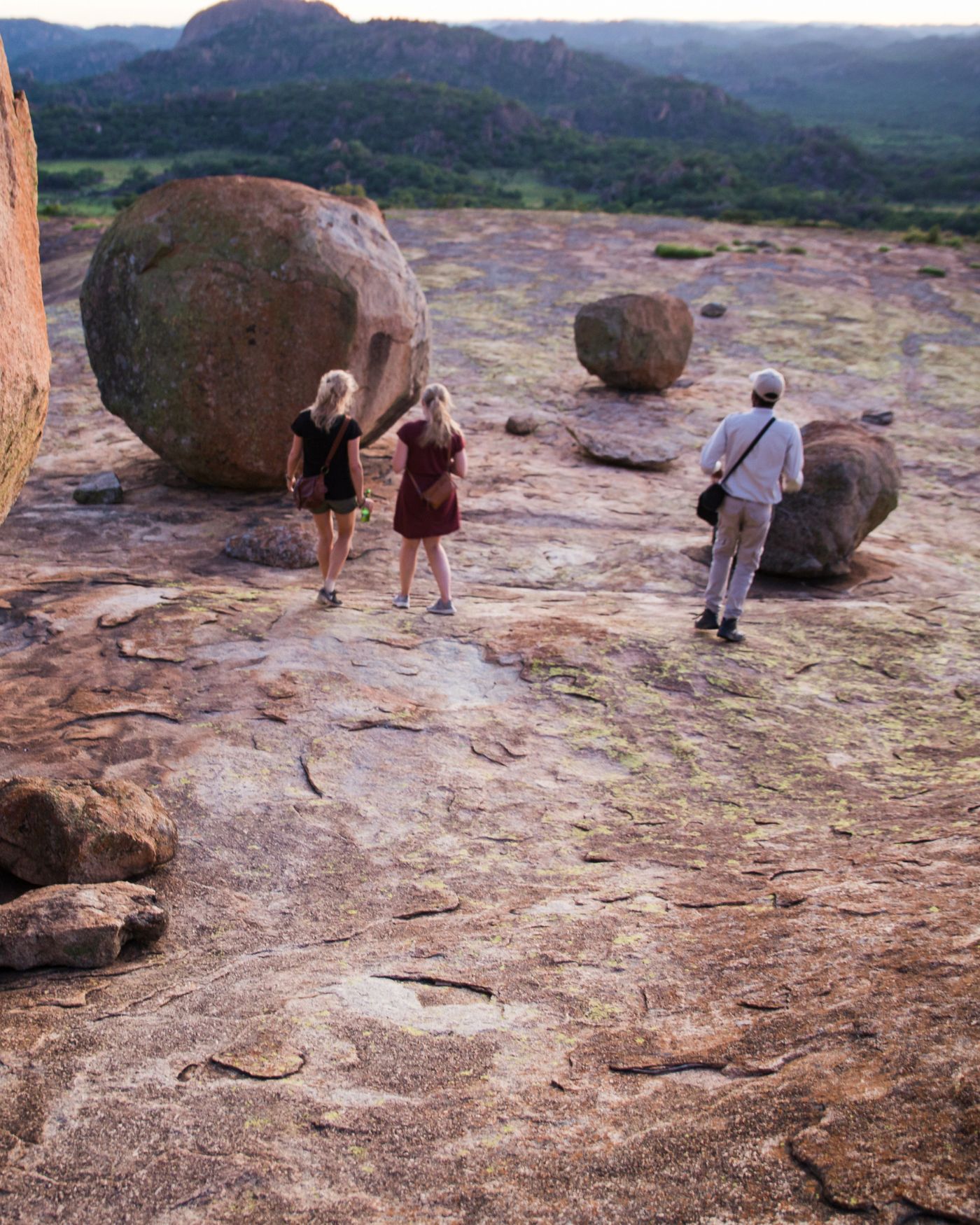
The walk to the top takes fifteen to twenty minutes at a relaxed pace. The path is cut into the granite — a set of shallow steps with a steel handrail on the steeper stretches. Dassies (rock hyraxes) watch from the boulders, and pairs of black eagles often circle the cliffs above; if you've timed the visit well, they are almost always there.

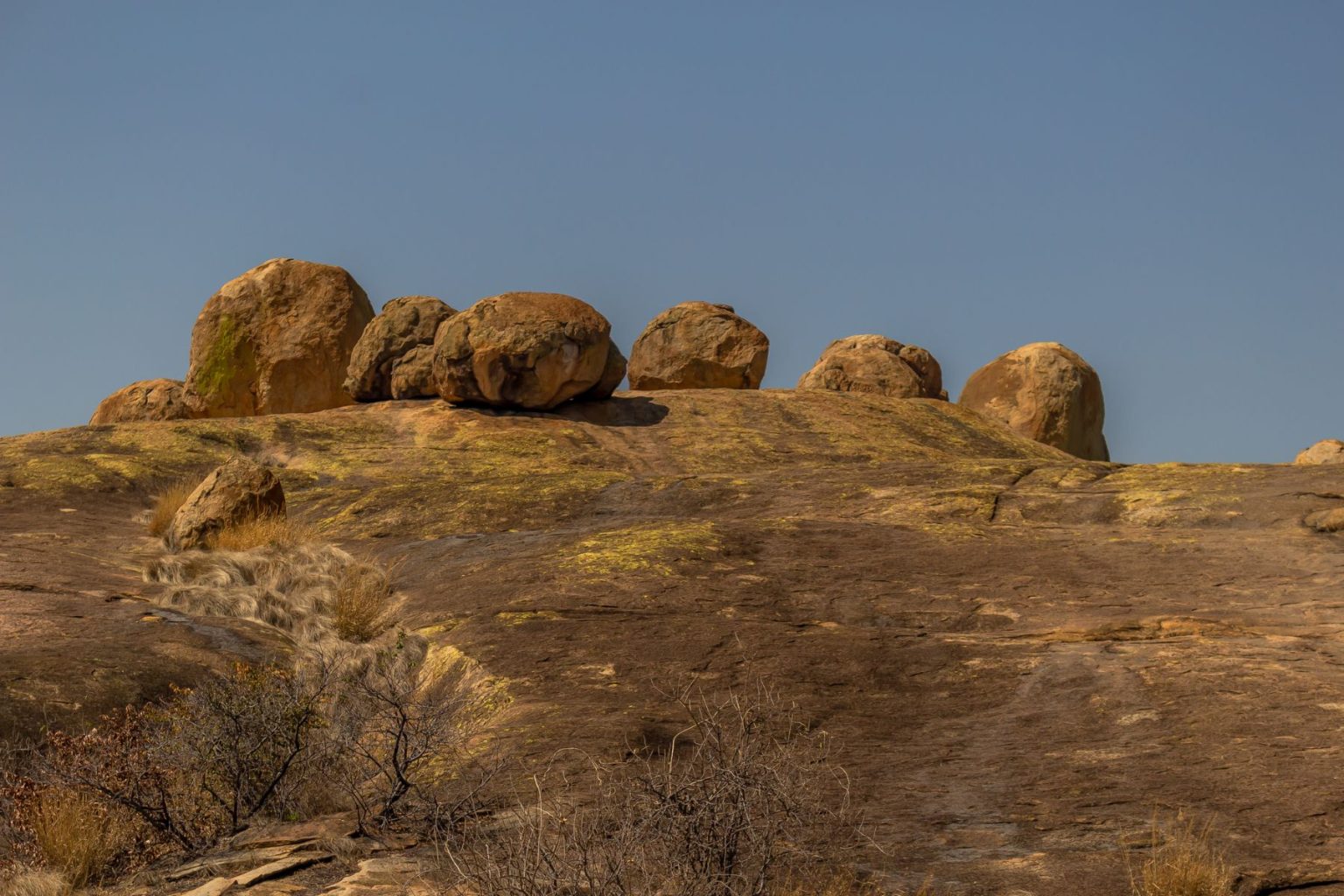
The approach to Malindidzimu summit in the Matobo Hills, with the cut-granite staircase rising through balancing boulders toward World's View
Malindidzimu from the approach. The final stretch is a series of shallow steps cut directly into the dome, winding between boulders that have been balanced there for millennia.

The last few metres flatten out and you arrive onto a broad granite shelf, open to the wind in every direction. Most people stop talking. It isn't a solemnity imposed by the graves — it's the scale of the view. The domes simply keep going. On a clear morning the horizon is more than sixty kilometres away, and the rhythm of the stone seems older than anything written.

Wide panoramic view from the summit of Malindidzimu / World's View looking out across the Matobo Hills, with two-billion-year-old granite whaleback domes rolling to the horizon
The view from the top. The horizon carries sixty or seventy kilometres on a clear day — a slow horizontal rhythm of granite domes that Rhodes is said to have called a View of the World.

Spend a little time here. Walk the perimeter of the summit before you approach the grave. Read the plaque, then read the Shangani frieze, then find a granite ledge out of the wind and sit for twenty minutes. The place rewards patience the way good landscape always does.

The Summit, Measured

Four numbers worth knowing

2 bn
Years — the age of the granite beneath your feet
1,460 m
Approximate altitude of the summit
15–20
Minutes on foot from the car park to the top
~45 km
South of Bulawayo by road
Visiting

How to visit well

The practical essentials for a morning or afternoon at World's View.

Getting there

From Matobo Hills Lodge, it is a short drive to the Matobo National Park gate, then roughly 25 minutes on well-signed park road to the World's View car park. A standard vehicle is fine in the dry season; a high-clearance vehicle is preferable after heavy rain.

Bulawayo is approximately 45 km to the north — allow 45 to 60 minutes from the city by road, depending on the route.

Fees & entry

Two fees apply at the gate and at the site: the standard Matobo National Park entry, plus a separate National Monument fee at the World's View car park. Both are collected by the Zimbabwe Parks and Wildlife Management Authority and are typically paid in USD cash.

We recommend checking the current amounts with the lodge before you travel, as fees are reviewed periodically.

When to go

Early morning or late afternoon. Midday light flattens the granite and bleaches the view; early and late light is warm, long, and photographic. The summit is exposed, so wind is a factor — a still morning is a gift.

The park is open year-round. The dry season (May–October) is most reliable for conditions; the green season (November–April) is quieter and the landscape holds more colour.

What to bring

  • Walking shoes with grip — the granite can be slick, especially if damp
  • A jersey or light jacket — the summit wind is colder than the car park
  • Water and a sun hat — there is no shade on the dome
  • A camera with a wide-angle lens if you have one
  • A quiet hour — the place does not reward rushing
Where to Stay

Matobo Hills Lodge as your base

Matobo Hills Lodge sits on the doorstep of Matobo National Park. From the lodge gate, World's View is an easy morning trip — short drive, short walk, back in time for a late breakfast on the deck.

Most guests pair a visit to the summit with one of the experiences alongside, either on the same day or the following morning. Our guides build the itinerary around light, weather, and what you want from the day; the suggestions below are the most common combinations.

Rhodes Grave · World's View Matobo Hills Lodge
Short drive · easy morning trip
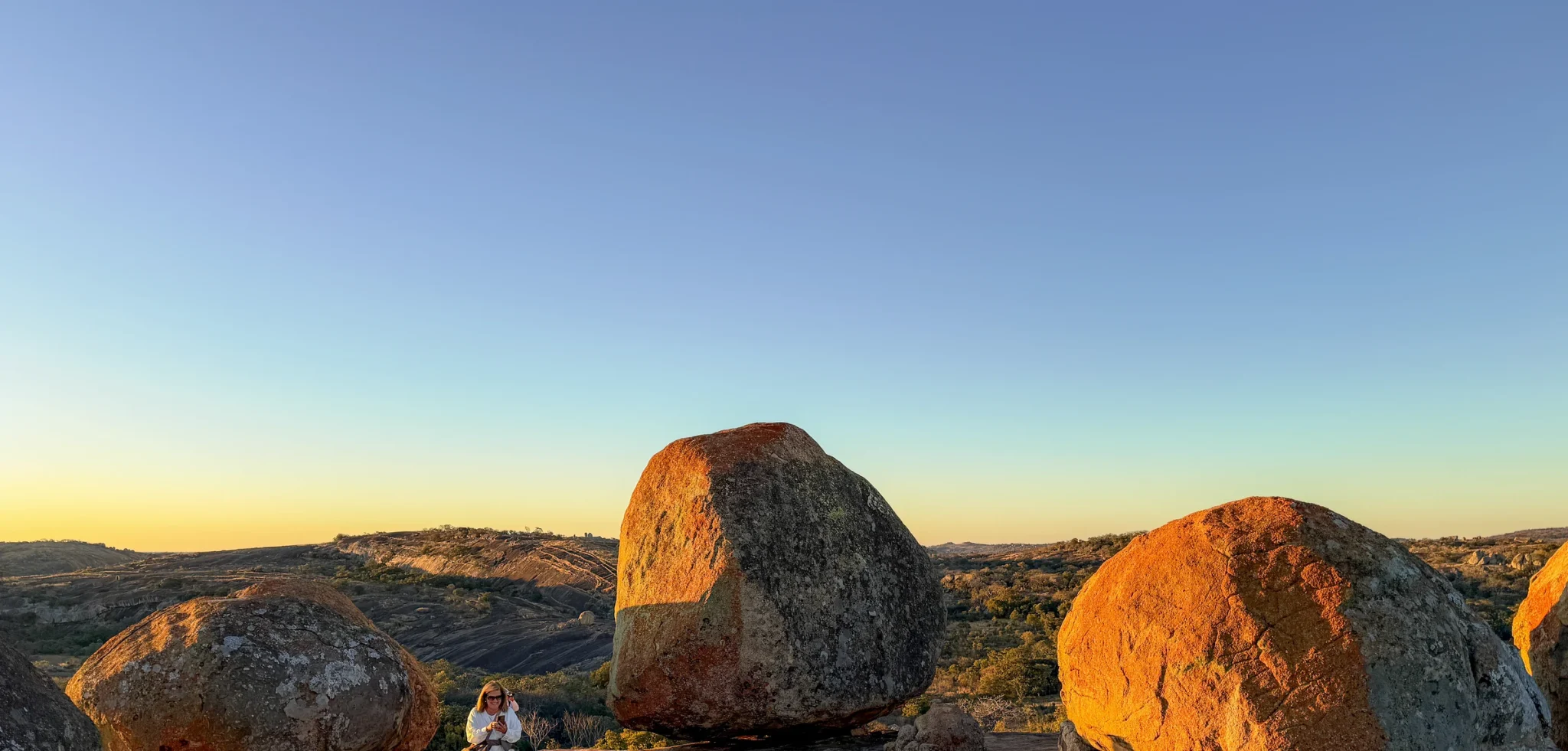
Granite kopjes of the Matobo Hills silhouetted against a warm dusk sky in Zimbabwe
Stay In The Hills

A short drive from the summit

Matobo Hills Lodge sits beside the park. Our guides build Rhodes Grave and World's View into morning itineraries alongside rhino tracking and the rock art caves. If Matobo is the reason you are coming, this is where to stay.

Frequently Asked

Questions we're often asked

Rhodes Grave is on the summit of Malindidzimu — also known as World's View — inside Matobo National Park in southwestern Zimbabwe, roughly 45 kilometres south of Bulawayo. The grave is a granite slab set into the summit of a whaleback dome, reached by a short drive through the park and a 15–20 minute walk up a cut-granite staircase.

Allow two to three hours in total from car park to car park. That covers the walk up, time at the summit, a short walk along the granite shelf to the Shangani Memorial, and the walk back down. Longer if you want to sit.

Yes. You pay the standard Matobo National Park entry fee at the park gate, plus a separate National Monument fee at the World's View car park. Both are collected by the Zimbabwe Parks and Wildlife Management Authority and are typically paid in USD cash. We recommend checking the current amounts with the lodge before you travel.

Yes. His remains are on the summit, interred by his own instruction in 1902. There has been periodic public debate about whether the grave should remain; as of 2026 it is still in place. Two adjacent graves — of Leander Starr Jameson and Sir Charles Coghlan — are also on the summit, and the Shangani Memorial sits a short walk away.

The summit is called Malindidzimu, usually rendered Place of Benevolent Spirits, and it is sacred ground in the Ndebele and Kalanga tradition — a site of ancestral connection that predates its colonial-era burials by a great deal. The wider Matobo Hills contain the Njelele shrines and the burial place of Mzilikazi, the first Ndebele king. Visitors are asked to treat the summit as the significant spiritual site it is.

Yes, and it is the most common way to spend a day in Matobo from the lodge. Most guests tackle rhino tracking on foot at first light, then drive to World's View for the late morning when the summit is still cool and the light is still warm on the granite. The order can be reversed depending on conditions.

Matobo Hills Lodge is the closest full-service lodge to the park gate and the World's View car park, and the most direct base for visitors focused on Matobo. For travellers driving in from Bulawayo it shortens the journey substantially and allows for an unhurried early-morning visit to the summit — the time of day it most rewards.

The walk is moderate — roughly 15–20 minutes up a stone staircase cut into the granite, with a steel handrail on the steeper sections. Guests who are comfortable with stairs will be fine at a relaxed pace. There is no shade on the dome, so the timing advice above matters: do it early or late, not at midday.