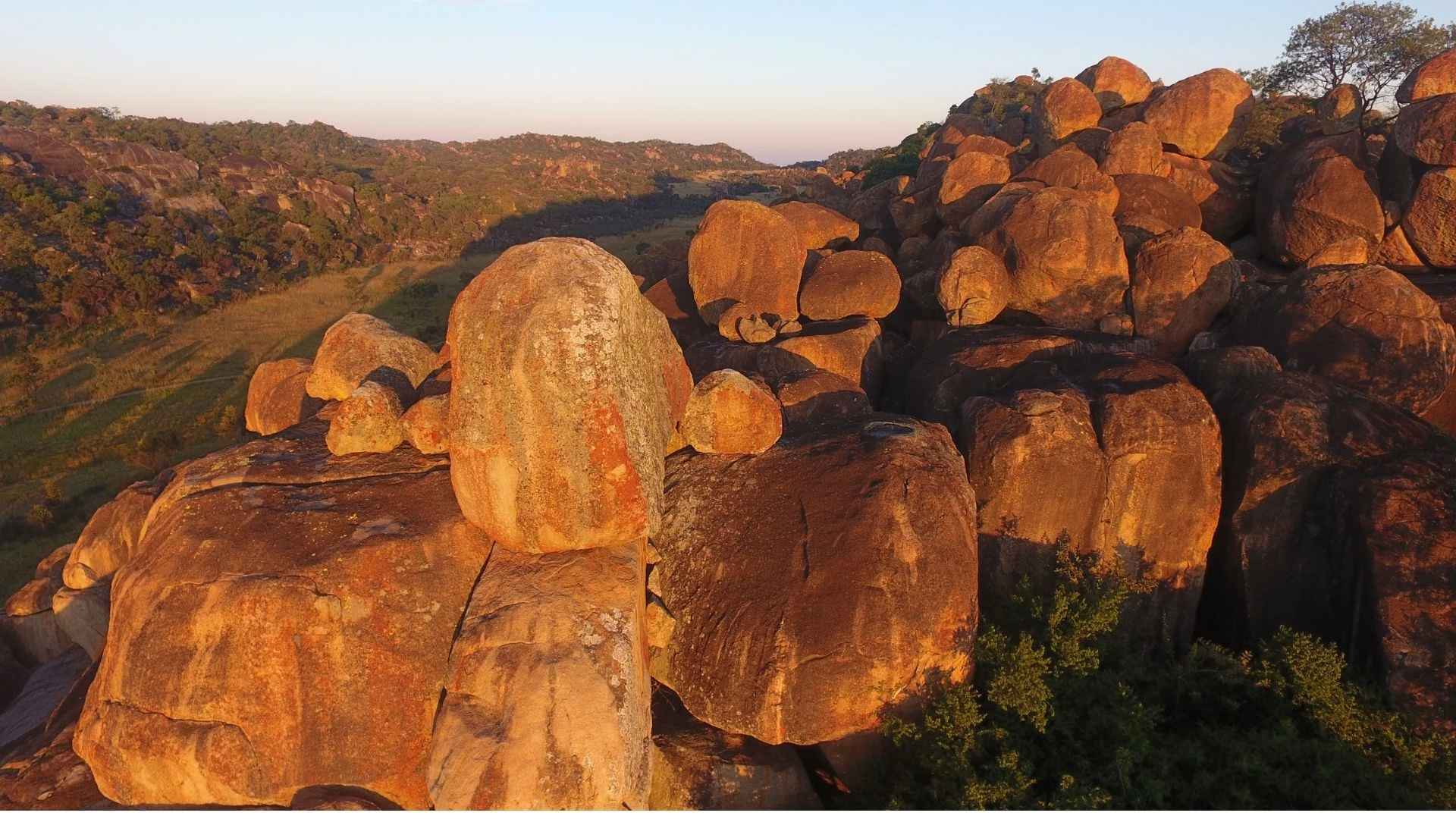
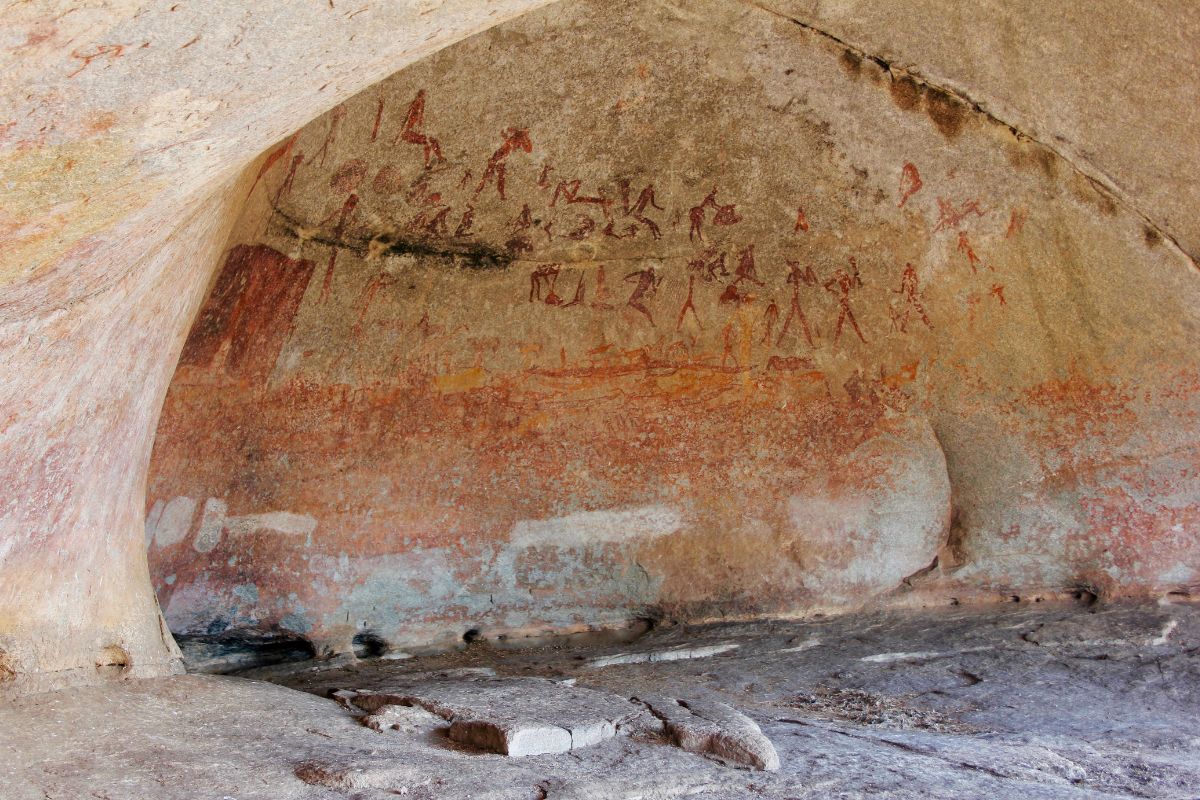
The oldest dated paint in these hills is about thirteen thousand years old. The youngest is about two thousand. In between, people came back to the same overhangs for eleven thousand years.
UNESCO puts human occupation of the Matobo at half a million years, with an almost unbroken association between people and this landscape across the last hundred thousand. The paintings are the late chapter of that, not the start of it.
Why the granite suited them
The hills gave the San everything a hunter-gatherer needs in one place. Overhangs that stay dry through the rains. Height to see game from. Valleys between the boulders that funnel animals along routes you can predict. And sheltered rock faces, out of the weather, smooth enough to hold pigment for a hundred centuries.
Ochre for the reds and yellows, ground to powder. Animal fat or blood as the binder. That mixture, on that rock, under that overhang, is why you can still see it.
It was never decoration
European researchers spent decades reading the paintings as picture-making by simple people. Scenes of the hunt. Daily life. They were wrong, and the correction came from a fairly unglamorous place: the ethnographic records of San communities who were still alive to be asked.
The work of David Lewis-Williams and others established what is now the standard reading. The art is religious. It was made by shamans, and it records what they saw during trance.
At the centre of San spiritual life was the healing dance. The community gathered, the women clapping and singing, the medicine men dancing round the circle for hours and sometimes all night, until the potency the San called n/om boiled in their bodies and they crossed over. They described that state as half-death. It came with nose bleeding, violent trembling, and the sensation of the body stretching.
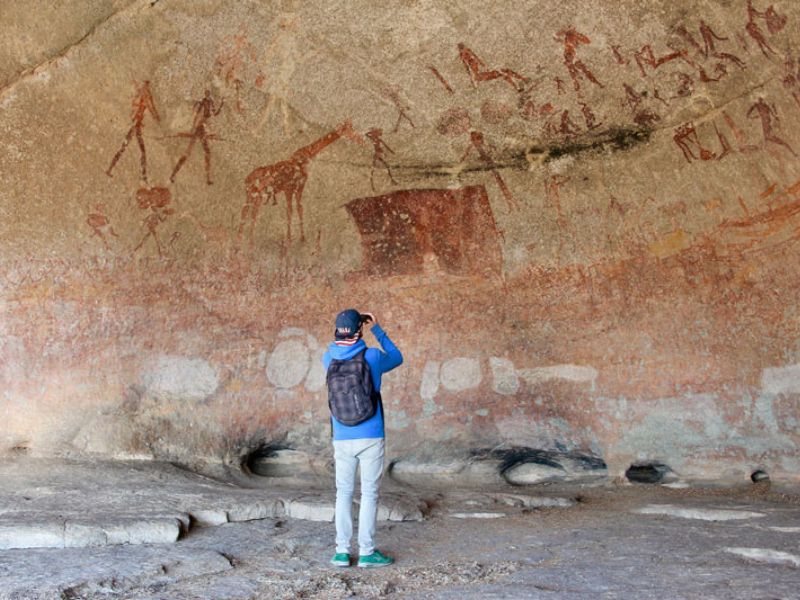
Now look again at the figures on the wall. The impossibly long limbs. The lines running from the nose. Those aren't a failure of draughtsmanship. They're an accurate record of what the painter felt happening to him.

Why it is nearly always eland
Visit enough caves and you notice that one animal outnumbers the rest. Eland, Africa's largest antelope, painted again and again.
It isn't because eland were easy to hunt. In San belief the dying eland released more n/om than any other creature. And the San word for entering trance is the same word as for dying. A shaman going under took on what a dying eland does: the stumble, the sweat, the lowered head, the blood at the nose.
So the eland isn't the subject of the painting. It's the mechanism.
Half-human figures, and what they are not
The therianthropes are the images people remember. A human body with an antelope head. A dancer with hooves. A crouching thing with human hands and animal haunches.
They aren't myth-creatures and they aren't fantasy. They are the moment of transformation, recorded from the inside, when a healer deep in trance felt himself becoming the animal whose power he had taken on.
The rock was not a canvas. It was the thin bit.
Which is why so many animals step out of a natural crack, and why so many figures reach through a ledge rather than standing on it. The spirit world was behind the stone. Painting was the act of bringing something through.
Formlings, which you will not see anywhere else
If one motif makes the Matobo distinct, it is the formling. Long clustered shapes, divided into narrow ovals, often in several colours. They are found almost nowhere else. Not in the Drakensberg, not anywhere else in Africa in this concentration.
What they mean is still argued about. Beehives seen in cutaway. Termite mounds. Or n/om itself, drawn as it was felt rising through the body. What nobody argues about is the craft. The frieze at Inanke carries sixteen linked formlings in yellow and orange, and it'd hold a wall in any gallery you care to name.

The caves, and what each one asks of you
- Nswatugi
- The introduction, and the best-preserved panel in the park. Five minutes from the car, a wooden walkway, and a wall of giraffe, zebra and kudu that goes rich in the afternoon light. Inside the National Park.
- Pomongwe
- The oldest, and the largest. Excavated on and off since the 1920s. The paintings are layered over each other across thousands of years. Some were wrecked by a 1920s attempt to preserve them with linseed oil, which is the best argument for the rules further down this page.
- White Rhino Shelter
- Two minutes from the tar. Small, and worth the stop for the rhino outlines, which are accurate enough to have helped make the case for reintroducing the animals in the 1960s. There's a galloping wildebeest herd in the top corner.
- Silozwane
- A steep twenty to thirty minute scramble through boulders, and the finest polychrome work in the region at the top of it. Outside the park, in communal land, so a community guide comes with you as well as ours.
- Inanke
- Seven kilometres each way from Toghwana Dam, about three hours in. A nine-metre frieze at eye level and the sixteen formlings. A full day, and not a casual one.
Most guests do Nswatugi and Pomongwe in a morning, and add White Rhino Shelter on the way back. Silozwane is a half day. Inanke you plan for.
The rules, which are not negotiable
- Don't touch the rock. Skin oil doesn't come off, and it's doing damage for a century after you leave.
- No water, no chalk, no oil, nothing to bring the colour up. Pomongwe is what that looks like a hundred years later.
- No flash. Ask your guide where to stand and the raking light does a better job anyway.
- Stay off the deposits. The floor of a cave like Pomongwe is an archaeological record, not a path.
The hills are still sacred, and not only because of the paint
Long after the San stopped painting, Silozwane became a shrine to the Mlimo, the oracle of the Ndebele. UNESCO calls the Mwari religion centred on these hills the most powerful oracular tradition in southern Africa, and describes the rocks themselves as the seat of god and of the ancestral spirits.
The shrines aren't historical. People still walk to them in the dry months. You are visiting a working religious landscape that happens to have thirteen thousand years of painting in it, and behaving accordingly costs you nothing.
Before you go
- When
- Late morning to mid-afternoon. The caves face out and the light has to get in. Early is the wrong end of the day for this one.
- Effort
- Nswatugi and Pomongwe are a stroll. Silozwane is a scramble. Inanke is a hike.
- Shoes
- Closed, with grip. Granite is generous when dry and treacherous when wet.
- Bring
- Water and a hat for the walking. A torch isn't needed and isn't wanted.
- Children
- Fine, at any age, on the accessible sites. Silozwane and Inanke are a judgement call about legs rather than about interest.
- Park entry
- US$18 per international adult per day for the sites inside the park, settled at the gate with the lodge.