
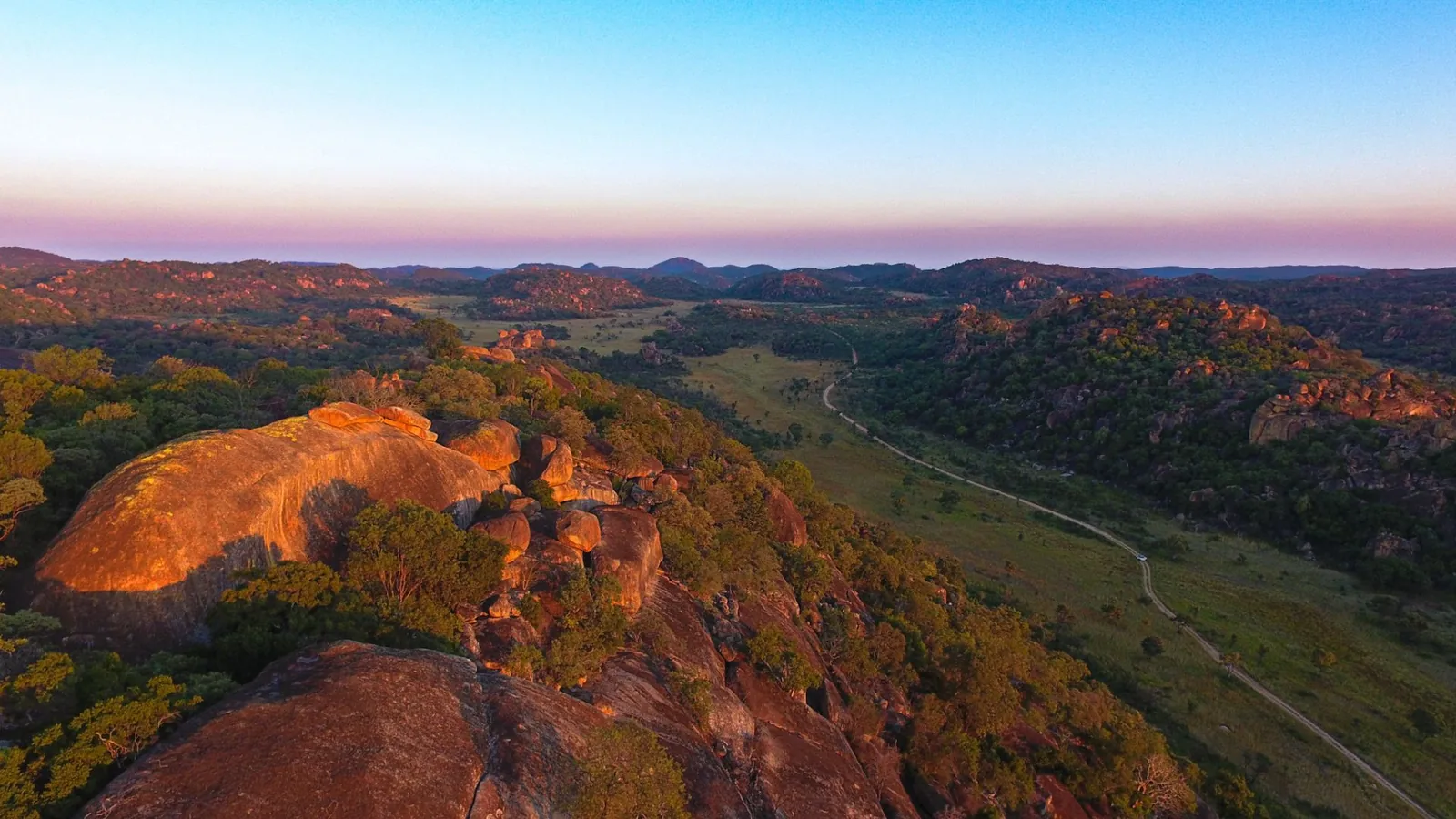
On the morning of 13 June 1896, a small, wiry major of the 13th Hussars climbed a kopje at the western end of the Matobo Hills, took out his notebook and looked south. He had come up from the Cape to help put down a rebellion.
Awful country, a weird, jumbled mass of grey granite boulders thickly interspersed with bush, and great jagged mountains.
Robert Baden-Powell, diary, 13 June 1896
The major was Robert Baden-Powell. I run a lodge in the country he was describing. It remains the worst review the Matobo Hills have ever had. It is also where the Boy Scouts began.
Ten days in a mule coach
Baden-Powell was thirty-nine, a few weeks home from the Ashanti campaign, when the telegram found him in Belfast. Sir Frederick Carrington wanted him as chief staff officer in Matabeleland. He sailed from Southampton on 2 May, took the train from Cape Town to the railhead at Mafeking, and then spent ten days and nights in a mule coach on the sand road north through Bechuanaland. Every mile of it, he wrote, stank of rinderpest. At one outspan the drivers counted three thousand two hundred dead oxen. He rolled into Bulawayo soon after midnight on 2 June.
For a week he sat in a commandeered mining office doing paperwork, with one morning off to ride in the fight at the Umguza River. Then the rumours from the hills got too vague to bear. On the evening of 12 June he rode out of town with the Company's Chief of Scouts, an American named Burnham, and slept a few hours at the fort on the Khami River. At four the next morning they set off again with a single trooper of the Mounted Police who knew the ground. They breakfasted at Mabukutwane, picked up Taylor, the Native Commissioner, and rode six miles across the veld to the kraal of a chief called Mapisa, who said he was on the Company's side. From the rocks above his huts they could see the whole western end of the Matobo, and the mountain called Inugu, where Lobengula had once kept his favourite queen because it was the safest place in the country.
That is where the notebook came out.
Why the hills were full of people
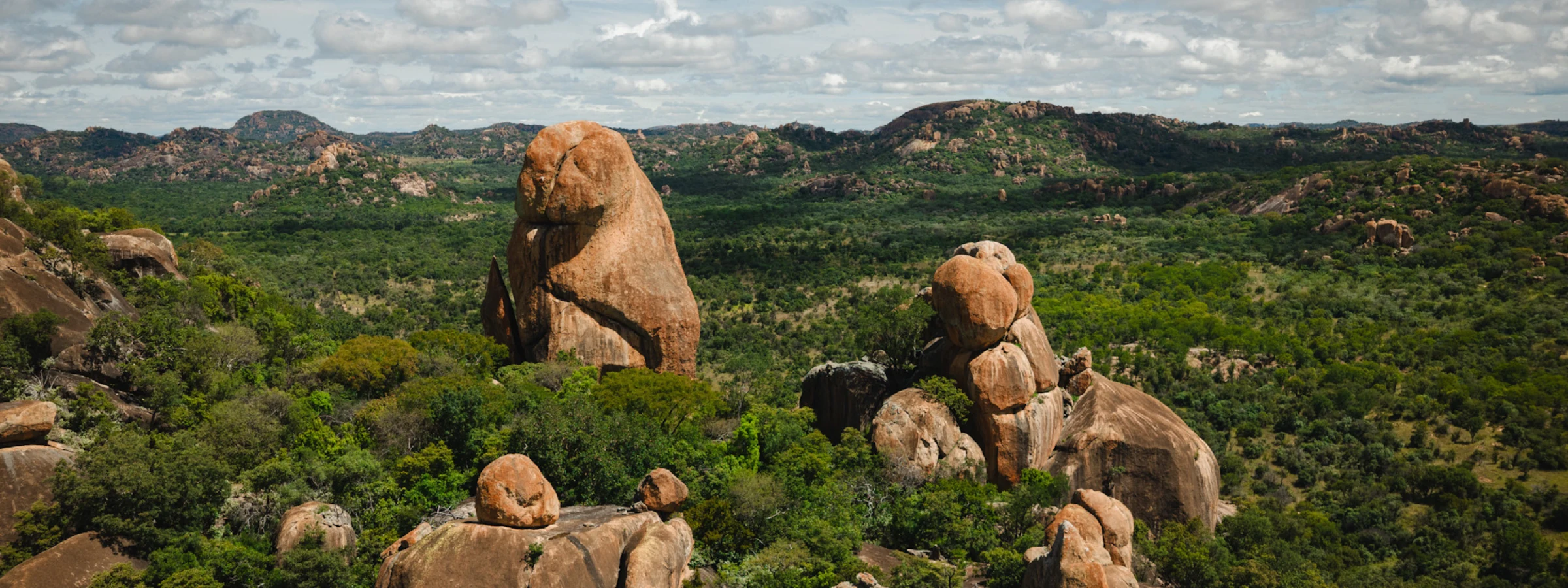
Three months earlier the Ndebele had risen against the British South Africa Company. They killed about 140 settlers in the first week and drove the survivors in Bulawayo into laager. Relief columns came up from the south with Maxim guns. Rather than face them on open ground, the Ndebele withdrew into the hills, taking their families, their grain and their cattle with them.
The Company they were fighting was not a government, though it had many of the powers of one. Cecil Rhodes had obtained a royal charter for it in 1889, allowing it to keep its own police, make laws and administer a territory larger than France. In 1893 its forces had broken the Ndebele kingdom in eleven weeks. The Company seized Lobengula's cattle to pay for the war, kept half and lent the rest back on terms it could revoke.
At the end of 1895 the Company's administrator, Leander Starr Jameson, led nearly 500 policemen south to overthrow the Boer republic of the Transvaal. Within days his force had been captured. Fewer than fifty policemen were left in Matabeleland.
Then rinderpest arrived from the north, killing the cattle the Company had not taken. To stop the disease spreading, the authorities shot healthy herds. To an Ndebele cattleman, a cow seized and a cow shot were much the same loss. The rains failed. Locusts came.
In the caves of the Matobo lived Mwari, the high god of the land, who sent rain and spoke through priests from within the rock. People had long travelled great distances to ask for rain and to have their troubles explained. The Ndebele, who had conquered Mwari's worshippers, had come to consult him too. Now the priests spoke of the drought, the locusts and the dying cattle. The whites had brought these disasters, they said. The white soldiers were gone, and if the people rose, Mwari would protect them: the white men's bullets would turn to water. By the third week of March the Ndebele regiments had risen, and the killing began.
The year in brief
- 29 December 1895. Jameson rides south into the Transvaal with most of the Company's police. Four days later they are prisoners.
- Late March 1896. The Ndebele rise. Bulawayo goes into laager; the regiments withdraw into the Matobo.
- 2 June. Baden-Powell arrives in Bulawayo as Carrington's chief staff officer.
- 13 June. "Awful country." His first look at the hills, from above Mapisa's kraal, with Burnham.
- 23 June. Burnham's telegram: he has shot a priest of the Mlimo in a cave near Mangwe.
- July and August. Baden-Powell scouts the hills alone with an Ndebele companion, then guides Plumer's column into them. The Ndebele name him Impeesa.
- 21 August. Rhodes rides unarmed into the Matobo for the first indaba. Jan Grootboom has gone in ahead of him.
- 13 October. The fourth and last indaba. Peace is formally ratified.
- 1 August 1907. Brownsea Island. Twenty boys are woken by a kudu horn from Matabeleland. The first Scout camp.
Sherlock Holmes
Baden-Powell and Burnham could see no army that morning. The people at the kraal said they were on the Company's side, and the soldiers kept their rifles in their hands anyway. Then Baden-Powell noticed a single cow in the distance, climbed onto a better rock and found a whole herd grazing in the valley directly below the rebel stronghold. He proposed a lark: ride down and round them up under the enemy's noses. The scouts from the kraal told him, a little awkwardly, that the cattle belonged to Farko, another "friendly" chief who lived near by.
He looked at the cattle for a while longer. Rebels take cattle from their enemies. Nobody had taken these. So Farko was not the rebels' enemy, and neither, in all likelihood, was Mapisa, whose huts they were sitting above. "That the enemy should leave these cattle untouched was a revelation to me," he wrote that night. The friendlies and the rebels were on perfectly good terms, and he had very nearly built his intelligence on their reports.

Burnham had been reading signs like these since he was a boy in the American West. He watched the Englishman worry out one small indication after another on the ride home and, before they reached Khami, had nicknamed him Sherlock Holmes. Baden-Powell was delighted. He put it in a letter to his mother, with the credit for his "inductive reasoning" going to her. Within weeks he was wearing a wide-brimmed cowboy Stetson like Burnham's.
Burnham was a small, quiet Californian who, by his own account, had tracked Apache at fourteen. In 1893 he put his wife and son on a ship to Durban and rode north to find a war. He found two. In the Company's campaign against Lobengula he was one of three men sent back for help on the night Allan Wilson's patrol died at the Shangani. In this second war, he claimed to have fired the decisive shot.
The shot in the cave
According to Burnham, he and a young Native Commissioner named Armstrong rode to a cave near Mangwe in late June, having been told that the Mlimo, the voice behind the rising, would come there to speak. They hid before dawn and waited all day. Towards evening an old man approached alone and began to dance at the mouth of the cave. Burnham shot him through the heart. The two men ran to their horses, set fire to the village below and rode through the night. In Bulawayo the general called it the turning point of the war. Rhodes sent his congratulations.

Others told a different story. Local chiefs said the dead man was Habangana, a priest of a minor shrine, not the Mlimo. Another account named him as Dshobani, an old man taken from his field, pushed into the cave and shot in the back. A judge, Watermeyer, was sent to inquire. His report has been lost, but a diarist in Bulawayo recorded him calling the whole affair a fake. One of Armstrong's messengers later admitted he had been paid to lie. And the western hills had not joined the rising at all. The war was being directed from the other side of the Matobo, where Burnham never went.
Baden-Powell's diary says only that Burnham was "soon afterwards compelled, for domestic reasons, to go down country". The scouting they had planned to do together never happened. Thirty years later, by then rich from oil, Burnham wrote his account in California. Baden-Powell kept wearing the hat.

Impeesa
With Burnham gone, Baden-Powell went scouting with an Ndebele companion whose name he never gives. In the manner of the time, he called him "my boy". Large patrols, he had decided, were of little use in the hills. What he preferred, he wrote, was to go with "my one boy, who can ride and spoor and can take charge of the horses" while he climbed about the rocks for a view. Two men could go where a column could not.
They slipped past the outposts at night and hid before first light, watching the rebels wake and light their fires. He wore rubber-soled shoes, because hobnailed boots skate on granite, and credited a youthful enthusiasm for skirt-dancing with the footwork that got him across the boulders when he was chased. The Ndebele saw him often enough to give him a name. His companion, waiting with the horses, heard them calling it across the valley and told him: Impeesa, "the beast that does not sleep, but sneaks about at night". Baden-Powell translated it as "the wolf". There are no wolves in the Matobo. Impisi is a hyena.

One day in July they found trampled grass that led them to footprints in a sandy patch: small feet, in sandals, on a long journey, heading for the hills. The scout gave a shout of surprise and picked up a leaf ten yards off the track. It was damp, and it smelled of beer. The tree it came from grew ten or fifteen miles away, and women plugged the mouths of their beer pots with its leaves as they walked.
So women had carried beer along this path. But when? The leaf lay well off the track, so the wind must have blown it there, and the only strong breeze that day had come at about four in the morning. The women, Baden-Powell concluded, had passed at four and reached the rebel camp by five. The men would not have waited to drink fresh beer, and by now would be, as he put it, "very comfortable, not to say half-stupid". The two scouts went up and had a good look at the camp.

Twelve years later the leaf appeared in Scouting for Boys as a lesson in tracking. The boy did not.
The diary admits more than the book. The Ndebele, Baden-Powell wrote, got their information almost entirely by reading spoor: a man's feet were always writing a message for his enemies, and "the practised eye of the native tracker" would read it however carefully you brushed out your prints. He was learning from the people he had been sent to fight.
Grootboom
He learnt, too, from Jan Grootboom, a Xhosa from the Cape who had come north driving a missionary's wagon. Baden-Powell called him a Zulu. Grootboom would walk into a rebel village dressed as one of its people, go in among the women and come out with the information he wanted; Baden-Powell rated him a man "of exceptional courage and soldierly ability", and the best scout he had. The white troopers praised him in the only terms they had. "His skin is black," one of Grey's Scouts said, "but he has a white man's heart." Grootboom, for his part, called the chief staff officer Colonel Baking-Powder.
By August Rhodes had accepted that the Maxims would not finish the war, and that he would have to talk to the people in the hills. Someone would have to go in first. Grootboom did, alone, shouting across the valleys to the indunas until a white flag went up on an agreed tree, and then walking in to arrange the meeting. On Friday 21 August Rhodes rode into the Matobo unarmed, with a doctor, an interpreter, a reporter from the Cape Times, and Grootboom and James Makunga leading the way.

The chief Somabulana stood and told Rhodes the history of his people from Mzilikazi onwards, and then what the Company's native police had done to them. A week later, at the second indaba below Usher's Kop, the indunas put down their weapons; the place is still called Lahlamkonto, where the spears were laid down. There were two more meetings before the peace was formally ratified on 13 October. The Company got its country back. Grootboom had opened the way.
A kudu horn in Dorset
Baden-Powell went home and turned his notebooks into an army manual, Aids to Scouting, in 1899. Then came the siege of Mafeking, which made him famous, and the discovery that boys in England were reading his soldiers' manual for fun. In the first week of August 1907 he took twenty boys to an experimental camp on Brownsea Island in Poole Harbour. Each morning he woke them with a kudu horn he had picked up in the Somabula forest in 1896, when it was an Ndebele signalling instrument.

The following year he published Scouting for Boys, in fortnightly parts, with the story of the beer-stained leaf in it. He had meant it as a handbook for existing youth organisations. Instead, boys began forming patrols of their own, and Baden-Powell found himself at the head of a movement. By 1909 there was a troop in Bulawayo, the 1st Bulawayo (Pioneer) Scouts, in the country where he had learnt some of what he now taught.
Nobody has written a book about them yet
I learnt Ndebele before I learnt English, from the people who worked for my parents in a safari camp in Hwange. The guides who walk my guests through the Matobo, TK and William, read the ground the way the boy with the leaf did. They know which tree a leaf came from, and how long a rhino has been gone from a patch of flattened grass, and which of the kopjes above a valley has somebody on it. Nobody has written a book about them yet.
Baden-Powell looked at this country and called it awful. Then he spent a winter being taught how to see it.
- The diary
- Baden-Powell, The Matabele Campaign, 1896 (Methuen, 1897). Out of copyright and freely available. The quotations, dates and all the sketches and photographs in this piece come from it.
- The shot
- Burnham's Scouting on Two Continents (1926) for his version; Terence Ranger's Revolt in Southern Rhodesia 1896 to 1897 (1967) for the chiefs' version and the inquiry.
- The indabas
- Hans Sauer's and Vere Stent's eyewitness accounts. Where the sources disagree, I have said so.


