No lion. No elephant. No vehicle queue circling a kill. What Matobo offers instead is something most modern safaris have lost — genuine wildness in an ancient landscape, where you approach a two-tonne rhino on foot, eagles the size of golden retrievers hunt twenty metres overhead, and the silence is only interrupted by things that live here.
White Rhino — The Signature Encounter
The Matobo Hills holds one of the highest densities of white rhino in the world. These are not recent introductions or fence-managed populations — they are a naturally thriving community in the rocky terrain they evolved for. The result is an encounter unlike anything in east Africa's famous parks: you meet them on foot.
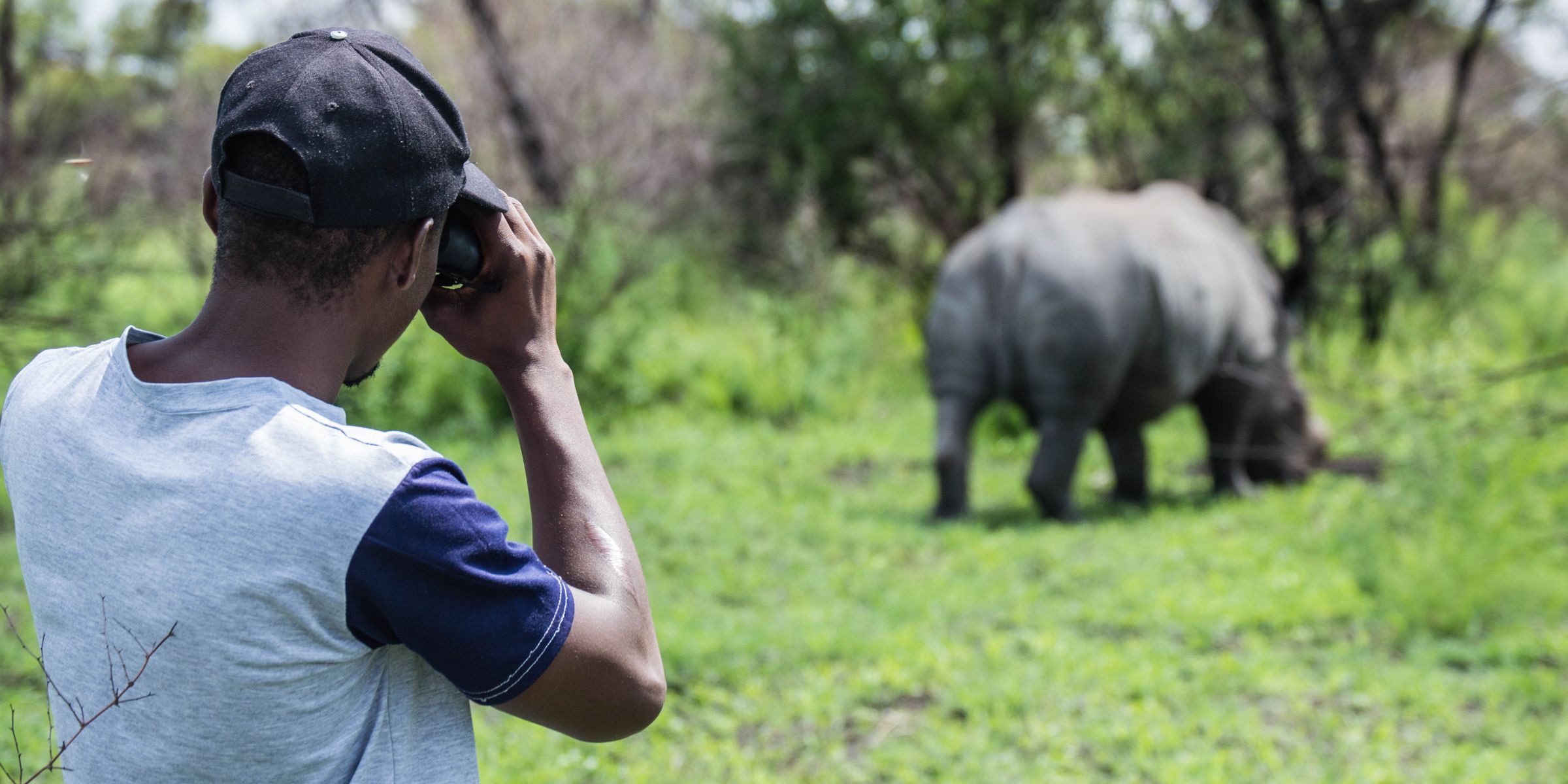
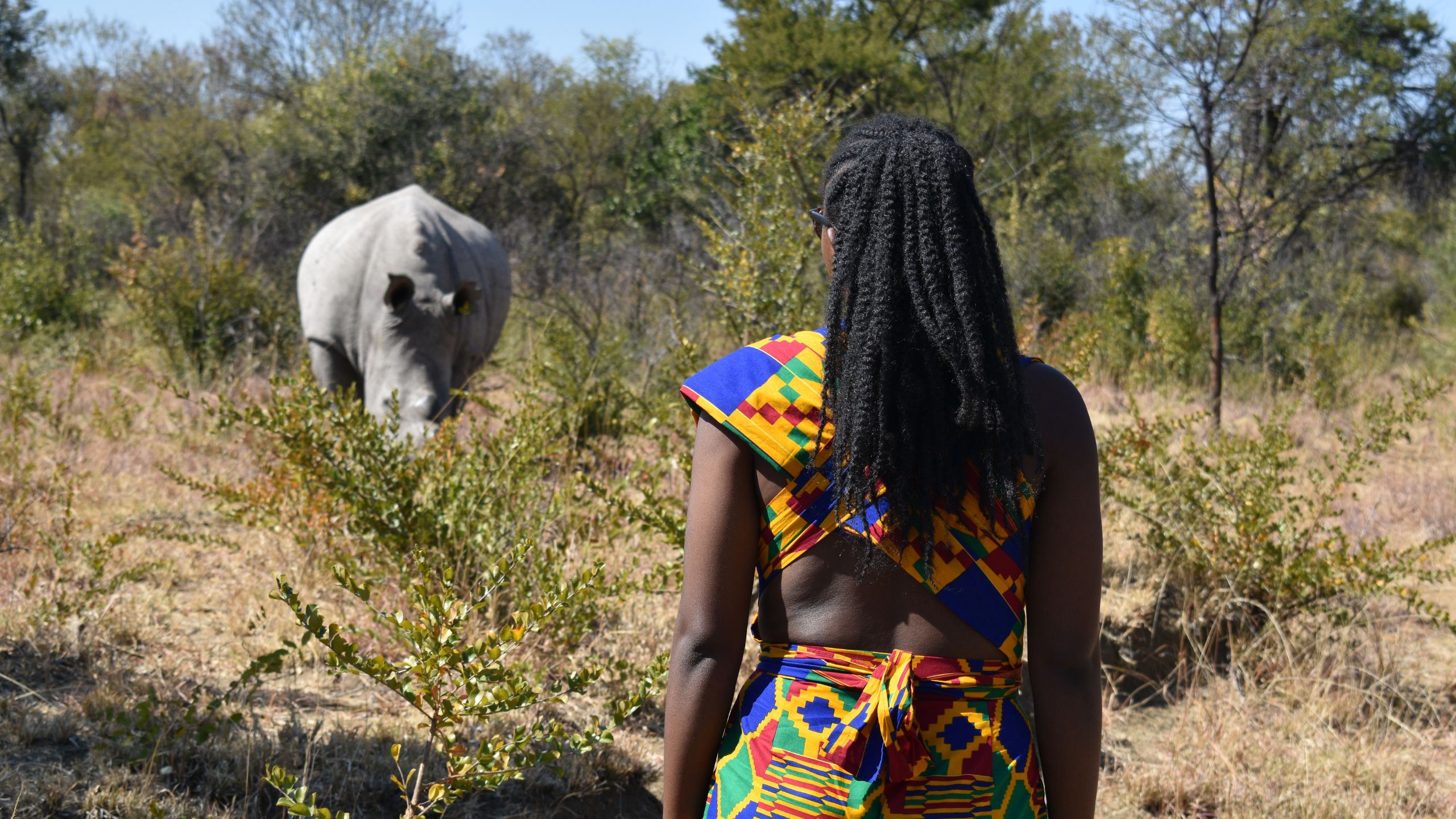
With a licensed guide, you leave the vehicle and track on foot across open grassland. Your guide reads the landscape — fresh dung, turned soil, the particular way the grass bends. When you find them, you approach slowly, into the wind, until you are twenty metres away. You hear a two-tonne animal breathing. You watch its ears rotate toward you as it processes the unfamiliar scent.
Then it looks at you, decides you are not worth the effort, and goes back to grazing. That moment — the moment of mutual assessment between a prehistoric megafauna and a modern human — is what Matobo does that nowhere else does quite the same way.
"There's a moment when everything else — the flights, the cost, the planning — becomes completely irrelevant. That's the moment you're standing twenty metres from a white rhino, on foot, in silence, watching it breathe."
Our guides carry a 90%+ sighting success rate during the dry season (May–October). Green season success drops to around 60–70% as vegetation thickens, but rhino tracking operates and delivers encounters year-round. We have never sent guests home without a rhino encounter across multiple sessions.
White rhino in the Matobo Hills — tracked on foot with licensed guides. Dry season sighting rate exceeds 90%.
Verreaux's Eagle — A World Record
The Matobo Hills holds the highest concentration of Verreaux's Eagles anywhere on Earth — over 60 breeding pairs nesting among the granite domes. These are not common birds. The Verreaux's Eagle is an apex raptor: jet black with brilliant white markings, a wingspan that stretches beyond two metres, perfectly adapted to hunting rock hyrax across the kopje terrain.
Watch them from any high point in the park and you will see them soaring — using the granite domes as thermal ramps, hanging in the updrafts above the boulder fields, then folding into a stoop that covers ground so fast your eye loses them. Between June and September, nesting season, the cliff ledges above the park become visible nurseries. Adults deliver hyrax to chicks with a precision that borders on mechanical.
On any given game drive at Matobo Hills Lodge, you will see multiple Verreaux's Eagles. This is not luck. This is density. No other place on Earth offers this consistently.
Verreaux's Eagle soaring over the Matobo kopjes. Over 60 breeding pairs call this landscape home — a world record density.
Leopard — The Elusive Cat
Matobo supports a healthy leopard population. The granite terrain — caves for denning, rocky outcrops for ambush, vertical relief that confounds prey — is ideal leopard country. These are not socialised leopards accustomed to tourist vehicles. They are genuinely wild, and finding them requires patience and the right conditions.
Best conditions: dry season, late afternoon, elevated ground. The leopards patrol familiar paths along cliff faces as the temperature drops. They are creatures of habit — the same cats use the same rocky corridors repeatedly. Our guides know these corridors.
Sightings are never guaranteed. They never should be. That unpredictability is precisely what makes a leopard encounter at Matobo feel like something the bush gave you, rather than something that was arranged for you.
Leopard in the granite terrain — the rocky kopjes and cave systems of Matobo are ideal denning and ambush habitat.
Plains Game — Surprising Diversity
Visitors consistently underestimate the diversity of wildlife in Matobo. The boulder-and-acacia terrain does not look like classic game country. It is. The park supports strong, stable populations of large mammals across a landscape that is genuinely wild — no fences, no feeding programmes, no management infrastructure that undercuts the experience.
Among the most visually striking antelope in Africa. The bulls — jet black with sweeping scimitar horns and a white face mask — are consistently voted among the most beautiful animals on the continent. Matobo's rocky grassland is ideal sable habitat.
Matobo's giraffes browse in the acacia woodland, their reticulated patterns framed by granite. Something about a giraffe at ease among boulders — animals that feel like they belong to the Cretaceous — captures the deep time of this landscape.
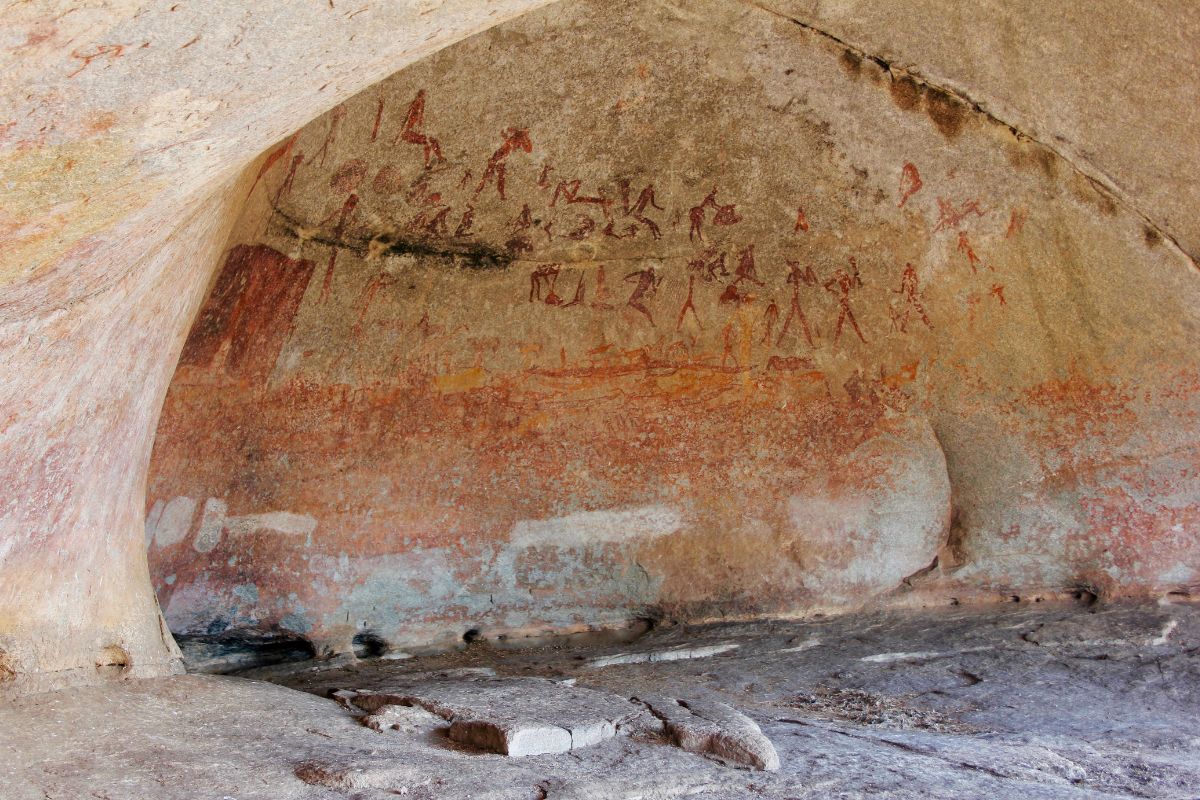
The largest antelope in Africa, and the most sacred to the San people who lived in these hills for millennia. Eland appear more than any other animal in the 3,000+ rock art sites scattered across Matobo — the San believed they held the most potent spiritual power. Seeing one here is therefore not simply a wildlife sighting.
Plains grazers found in mixed herds across the open grassland areas. Reliable viewing from game drives, particularly around the Maleme Dam where animals concentrate during the dry season. April brings impala lambs — a predator magnet that makes this one of the most dynamic wildlife months.
The Granite Ecosystem — Smaller Wildlife
The kopje habitat is a world unto itself. Most guests arrive focused on rhino and eagles, and leave talking about something they didn't expect — a klipspringer standing motionless on a vertical granite face twenty metres above them, or a troop of chacma baboons moving through the boulders at dusk, or the moment a hyrax colony erupted from a warm ledge as a Verreaux's Eagle passed overhead. Matobo's smaller wildlife is not background noise. It is the texture of the place.
Klipspringer
The klipspringer is one of the most remarkable animals in the park, and one of the most overlooked. A small antelope — barely knee-high — that walks on the very tips of its hooves like a ballet dancer on pointe, allowing it to navigate vertical granite faces that would defeat any other hoofed animal. They are perfectly adapted to this specific terrain: their coat is coarse and hollow, cushioning impact on rock; their hooves small, cylindrical, grippy on granite. Find a steep kopje face and scan slowly. There is almost certainly a klipspringer on it, standing motionless, watching you with a calm that suggests it has never once been in danger on terrain like this.
Klipspringer on the granite — walking on the tips of cylindrical hooves, at home on vertical rock faces no other antelope would attempt.
Rock Hyrax (Dassie)
Furry, sociable, and improbably related to the elephant — the rock hyrax is the ecological cornerstone of the Matobo kopje system. They live in colonies throughout the boulder fields, sunning on warm granite in the morning in groups of ten to thirty, communicating through an elaborate vocabulary of squeaks and barks that carry across the hills. They are the primary prey of the Verreaux's Eagle. Watching a hyrax colony on a warm granite ledge is watching the bottom of a food chain whose apex arrives at 150 kilometres per hour from directly above. The hyrax know this. Watch their eyes — they never stop scanning the sky.
Rock hyrax (dassie) on warm granite — improbably related to the elephant, and the primary reason Matobo has the world's highest density of Verreaux's Eagles.
Vervet Monkeys & Chacma Baboons
Both species are present throughout the park and around the lodge. Vervet monkeys move through the acacia canopy in troops, quick and curious, often the first animals to announce a predator's presence with their sharp alarm calls. Chacma baboons are a more substantial proposition — large, intelligent troops that work the kopje terrain with a confidence that comes from generations of familiarity with this landscape. The big males, faces scarred from troop disputes, move with a deliberate authority that is easy to underestimate. Both species interact with the broader food chain in ways that make them worth watching closely: a baboon troop in alarm is frequently telling you that a leopard is nearby.
Vervet monkey in the lodge grounds — quick, curious, and among the first to alarm-call when a predator is near.
Lizards, Skinks & Reptiles
The granite slopes support a dazzling range of brightly coloured lizards and skinks that are unique to this rocky habitat. Flat lizards — males iridescent in electric blue, orange and green — display on sun-warmed boulders. Agamas bask on rocks throughout the day, their heads colour-shifting to vivid red-orange when a rival appears. Monitor lizards, the largest reptiles in the park, patrol the lodge margins and riverbanks. After dark, chameleons emerge in the vegetation perimeter — guests who walk the grounds with a torch regularly find them motionless in the low shrubs, eyes rotating independently, entirely unconcerned. Several species here are endemic to this specific granite biome and found nowhere else.
The granite kopjes support a dazzling range of lizards and skinks found nowhere else — iridescent, territorial, and utterly at home on vertical rock.
Birdlife — One of Africa's Premier Sites
Over 500 bird species have been recorded in the Matobo Hills. BirdLife International has designated the area an Important Bird Area. The granite habitat supports specialists that are found nowhere else in this density, and November to March brings over 200 migratory species from Eurasia and central Africa.
Wildlife by Season
Every season in Matobo changes what you see and how you see it. The right season depends entirely on what matters most to you.
Dry Season — The Classic Safari Window
Vegetation thins progressively from May through October, opening sightlines and concentrating animals around permanent water sources. This is when Matobo performs at its most spectacular for game viewing: rhino tracking success rates peak above 90%, leopard patrols are predictable, and eagle activity intensifies as prey becomes more visible.
Temperatures are comfortable — warm middays, cold mornings and evenings (5–10°C at dawn in June–July). Bring layers. The crystal-clear winter sky means extraordinary night photography and stargazing. No dust haze. No rain interrupting activities.
Green Season — A Different Matobo
The rains transform the hills entirely. Overnight the granite valleys fill with green, wildflowers appear on the kopje faces, and the landscape becomes the most photogenic version of itself. Over 200 migratory bird species arrive — the total bird count can exceed 500 on a good day in January or February.
Game viewing becomes harder as vegetation thickens, but never impossible. Rhino are still found; the landscape just requires more patience. Rates are at their lowest. If you want Matobo largely to yourself, the green season is when it happens.
Peak Wildlife Months — August to October
If you can only come once and you want the most concentrated wildlife experience available, aim for August to October. Vegetation is at its thinnest. Animals are desperate for water and concentrate around every remaining source. Temperatures are rising — uncomfortable by midday in October, but the early morning and evening game drive windows are extraordinary.
October is the hottest month and the most demanding for visitors. It is also, in our guides' consistent assessment, the month that produces the single most intense wildlife encounters. Animals at waterholes in October are not cautious — they are focused on survival, and that focus makes them tolerant of close observation.
The Matobo Hills sits at 1,400 metres elevation — 3–5°C cooler than lowland Zimbabwe parks and classified as low malaria risk year-round. Many visitors choose not to take prophylaxis; the decision is personal and medical advice from your travel doctor should guide it. This is one of the few safari destinations in sub-Saharan Africa where families, children, and immunocompromised visitors can travel with significantly reduced health concern.
Matobo vs Other Zimbabwe Parks
Every Zimbabwe park offers something different. Here is how the Matobo Hills compares across the factors that matter most to wildlife travellers.
The road into Matobo National Park — 45 minutes from Bulawayo, a billion years in the making.
Frequently Asked Questions
The wildlife is here.
The only question is when.
Tell us your dates and we will build the right itinerary — rhino tracking, game drives, rock art walks, and the right season for what you want to see.