
The Best Safari Lodges in Zimbabwe — and Why Matobo Should Be on Your List
Zimbabwe is one of Africa’s most underrated safari destinations. The wildlife is exceptional, the parks are uncrowded, and the value — compared to Kenya, Tanzania or Botswana — is remarkable. The question isn’t whether to go. It’s where to stay.
This guide covers the best safari lodges in Zimbabwe across the country’s key destinations — Hwange, Victoria Falls, Mana Pools, and the Matobo Hills — with an honest take on what each region offers and who it suits best.
We’re based in Matobo, so we’ll say upfront: we think it’s the most extraordinary destination in Zimbabwe. But we’ll make the case properly and let you decide.
Zimbabwe’s Safari Regions — A Quick Overview
Zimbabwe has four distinct safari regions, each with a completely different character:
Zimbabwe’s Main Safari Destinations
- Hwange National Park — Zimbabwe’s largest park, famous for massive elephant herds and excellent Big Five game viewing. Best for classic African safari photography.
- Victoria Falls — One of the Seven Natural Wonders of the World. A spectacular base for adventure activities alongside wildlife. More touristy than other regions.
- Mana Pools — Remote, wild, and UNESCO-listed. Walking safaris with no fences, where guides carry rifles and buffalo cross your path. Not for first-timers.
- Matobo Hills — A UNESCO World Heritage Site unlike anywhere else in Africa. Ancient San rock art, white rhino tracking on foot, dramatic granite landscapes, and a density of history and wildlife in a compact area. The most diverse safari experience in Zimbabwe.

The Best Safari Lodges in Zimbabwe by Region
Hwange National Park
Hwange is the engine room of Zimbabwe’s safari industry. The big game is superb — particularly elephants, lion, and wild dog — and there are lodges to suit every budget from rustic bush camps to high-end tented camps. For wildlife photography and classic Big Five game drives, it’s hard to beat. If seeing elephants in vast numbers is your priority, Hwange delivers.
The park covers over 14,000 square kilometres of flat mopane woodland and Kalahari sandveld — a landscape very different from Matobo’s dramatic granite hills. The defining experience is the waterhole. During the dry season, artificial pumping stations draw wildlife from across the park, and the famous Nyamandhlovu Pan viewing platform delivers reliable sightings of herds that can number in the hundreds. Hwange’s elephant population — estimated at over 40,000 — is one of the largest concentrations on the continent, and watching a breeding herd arrive at a waterhole at dusk is a genuinely humbling experience.
Safari in Hwange is predominantly vehicle-based. Walking safaris are offered by some of the more remote camps, but game drive vehicles are the primary tool. The landscape rewards patience and a long lens. What Hwange doesn’t offer is the cultural depth or the dramatic scenery of other Zimbabwe destinations — it’s a wildlife park, focused and excellent at exactly that.
Victoria Falls
The Falls are genuinely unmissable, and the lodge scene has improved significantly in recent years. Most visitors combine a night or two here with a safari elsewhere in Zimbabwe. It works well as an arrival or departure point. The wildlife in the immediate area is limited compared to dedicated safari parks, but the spectacle of the Falls and the activities — white-water rafting, microlight flights, zip-lining — are world-class.
Mosi-oa-Tunya — “the smoke that thunders” — is 1.7 kilometres wide and drops 108 metres into the Batoka Gorge. At peak flow between March and May, the spray rises over 400 metres and the roar carries for kilometres. At lower water levels in September and October, you can walk across exposed rock faces and peer directly into the gorge. Both versions are extraordinary, just different. The town itself has become quite commercial — souvenir stalls, bungee operators, curio shops — but the Falls themselves remain completely overwhelming regardless.
Victoria Falls works best as a two-night bookend rather than a safari destination in its own right. Fly in, spend an afternoon at the Falls, do one activity, have a good dinner, and move on. The guests who stay four or five nights generally wish they’d spent some of that time somewhere quieter and wilder.
Mana Pools
Mana Pools is Zimbabwe’s most remote and wild destination. Walking safaris here, with trained guides and no vehicle barrier between you and the animals, are genuinely extraordinary. The landscape — floodplains along the Zambezi, towering albida trees — is stunning. This is a destination for experienced safari travellers who want something raw and unfiltered.
The Zambezi floodplains in October, just before the rains, are unlike anywhere else in Africa. Albida trees shed protein-rich pods that draw elephant in extraordinary numbers — and Mana Pools is famous for the image of elephants standing on their hind legs, stretching ten feet into the air to reach the highest pods. Canoe safaris along the Zambezi, drifting past hippo pods and elephant drinking on the bank, represent some of the most immersive wildlife experiences available on the continent. The combination of walking, canoeing and vehicle safaris in a single camp makes Mana Pools uniquely varied.
The honest caveat: Mana Pools is genuinely difficult to get to, expensive, and closed between November and April when the road floods. It rewards travellers who have done Africa before and are ready to go deeper. If you’re combining it with Matobo, a circuit of Mana Pools (fly-in from Harare) and Matobo (fly into Bulawayo) gives you Zimbabwe’s most extraordinary walking safari landscape alongside its most extraordinary cultural landscape — two completely different experiences, both world-class.
Matobo Hills — the Case for Going Off the Beaten Track
Most international visitors fly straight to Hwange or Victoria Falls and miss the Matobo Hills entirely. That’s changing — slowly — but Matobo remains one of Zimbabwe’s best-kept secrets, and one of Africa’s most extraordinary destinations.

Here’s what you get in Matobo that you can’t get anywhere else in Africa:
- White rhino tracking on foot — one of the world’s most intimate wildlife encounters, possible here because the park has one of Africa’s highest concentrations of white rhino
- San rock art — over 3,000 documented sites containing some of the oldest cave paintings on Earth, dating back 40,000 years
- World’s View — Cecil Rhodes’ burial site, a hilltop balancing-rock panorama with 360-degree views across the wilderness
- Ndebele cultural visits — authentic engagement with the local community, not a performance
- No crowds — Matobo receives a fraction of the visitors that Hwange and Victoria Falls see, which means the experience is genuinely personal
Ready to see Matobo for yourself?
Matobo Hills Lodge is the only private lodge inside the national park. Packages from B&B ($154pp) to All-Inclusive ($395pp).
Why Matobo Hills Lodge is the Best Base for the Region
There are a handful of accommodation options near the Matobo Hills. Matobo Hills Lodge is the only one located inside Matobo National Park itself — not on the edge of it, not nearby, but within the boundaries of the UNESCO World Heritage Site.
That matters more than it might sound. Being inside the park means your morning game drive starts from your doorstep. The granite landscape is right outside your chalet window. You fall asleep to the sounds of the wilderness rather than a farm or a suburb.
The Accommodation
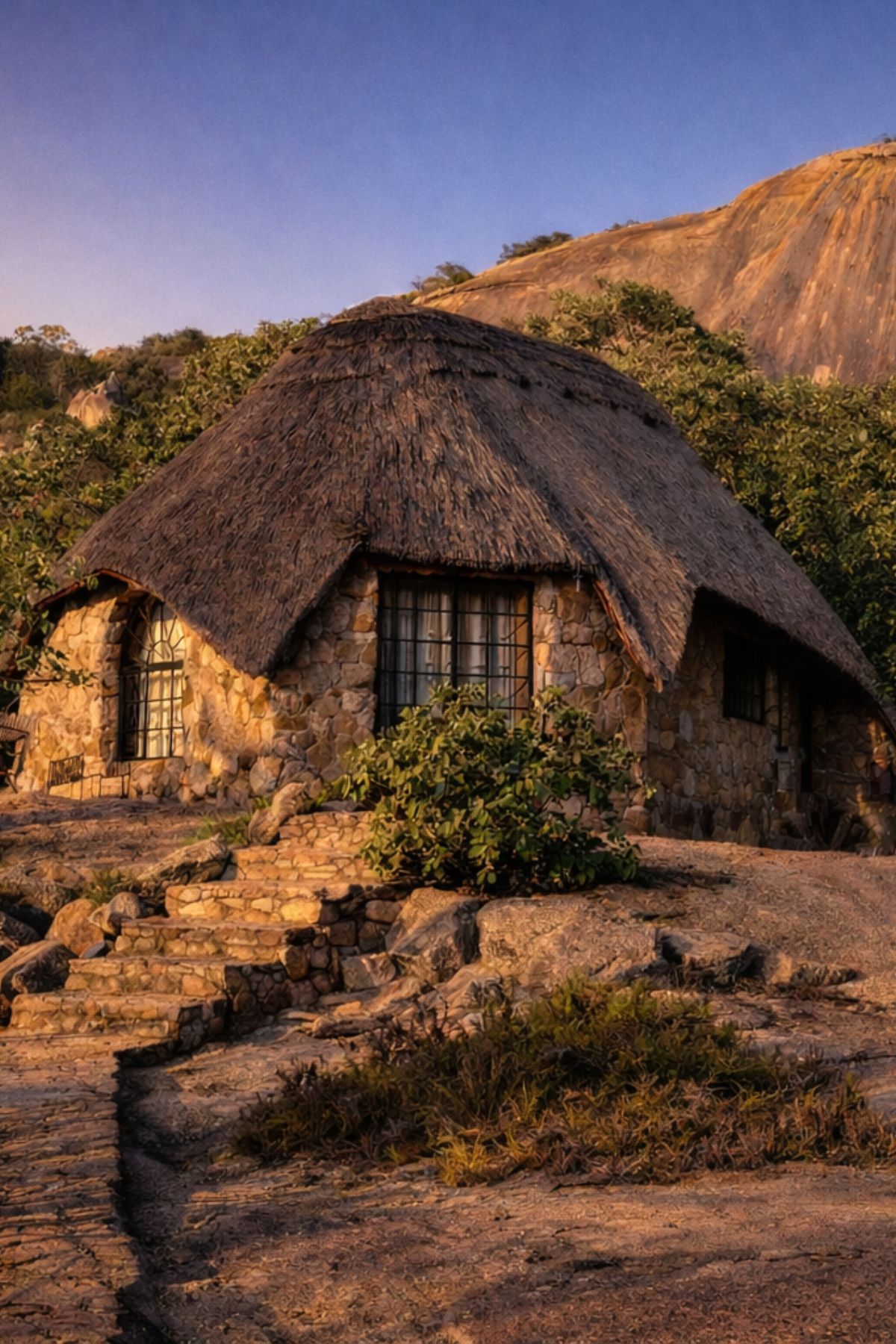
The lodge has 17 stone-and-thatch bush chalets, each with a private verandah looking out over the granite hills. Rooms are simple, comfortable, and well-designed — this isn’t a hotel pretending to be a bush camp. It’s a bush camp that takes comfort seriously. All rates are fully inclusive: park fees, guided activities, breakfast, lunch and dinner are included.

The Wildlife
The headline experience is white rhino tracking on foot. You walk with a guide through the park until you find rhino, then approach slowly on foot. It’s one of the most extraordinary wildlife encounters available anywhere in Africa — intimate, unscripted, and genuinely wild. Matobo has one of the highest concentrations of white rhino on the continent.

The Rock Art
The San rock art in Matobo is extraordinary. Over 3,000 sites have been documented within the national park — paintings created by the San people over 40,000 years, depicting shamanic visions, animals, and figures that still puzzle scholars. Guided walks to the cave sites are included in every stay.

The Food
Meals at Matobo Hills Lodge are a genuine highlight. Breakfast on the deck, sundowner drinks on the kopjes, dinner under the stars. The kitchen uses local ingredients and cooks with real care — not the reheated buffet circuit you find at some larger safari lodges.

How to Choose the Right Zimbabwe Safari Lodge
The honest answer is: it depends what you’re after. Here’s a simple framework, with a longer side-by-side in Matobo vs Hwange vs Mana Pools:
Match your priorities to the right destination
- Big Five, classic game drives, photography → Hwange National Park
- Adventure activities + iconic natural wonder → Victoria Falls
- Remote, walking-safari wilderness experience → Mana Pools
- UNESCO landscape, rock art, rhino on foot, no crowds, cultural depth → Matobo Hills Lodge
- Best Zimbabwe circuit → Matobo Hills Lodge (3 nights) + Hwange or Victoria Falls (2–3 nights)
If you’re doing Zimbabwe for the first time and want to see as much as possible, a circuit combining Matobo and Hwange (or Matobo and Victoria Falls) gives you extraordinary variety in a short time. Many of our guests fly into Bulawayo, spend 3 nights at Matobo, then connect to Hwange or Vic Falls before flying home.
Practical Information: Getting to Matobo Hills Lodge
The lodge is a 55-minute drive from Bulawayo, Zimbabwe’s second city. Bulawayo has direct Airlink flights from Johannesburg (under 2 hours). From Johannesburg, you can connect from most major international hubs. Transfers from Bulawayo to the lodge can be arranged directly with us.
Planning from the UK or US?
- Zimbabwe safari holiday from the UK — flights, visas, itineraries and 2026 rates for British travellers
- Zimbabwe safari vacation from the US — everything American travellers need to plan a Zimbabwe trip
Plan Your Zimbabwe Safari
Matobo Hills Lodge is the only accommodation inside Matobo National Park — UNESCO World Heritage Site. 17 chalets, fully inclusive rates, guided activities from your doorstep.